Indigenous · History Classes · Grades 10–13 · College · University
The Watchers in the Texts — Enoch, Jubilees, and the Nations of Giants
History Class · Level band: Grades 10–13 · College · University
English edition — the language editions of the history classes are outstanding and will follow the site’s translation pattern; none is fabricated here.
OWNER'S TEACHING — the head of this class
Class: OWNER'S TEACHING. David's teaching (2026-10-28), standing as OWNER'S TEACHING, never flattened into the record:
“I don't believe in aliens. I believe they're fallen angels in the account of Noah.”
In his teaching, the beings of the modern doctrines are the fallen angels of the Noah account and their crossbred offspring — the Watchers who came down, took wives, begot the giants, corrupted the earth, and whose spirits the texts say remain on the earth. That identification is his; the texts below stand at their own weight, unaltered by it.
“He may know the star system they came from but I know that they are fallen angels.”
Class: OWNER'S TEACHING (2026-10-28 20:53). His knowledge names what they ARE; any knowledge of where they are said to come from stands under it, not beside it as an equal.
“I also know from the Infancy Gospel of Thomas that Yeshua was said He is before all worlds — this informs me that there are other worlds beyond our own.”
Class: OWNER'S TEACHING (2026-10-28 20:54). The teaching's second edge stands with it, printed whole: other worlds beyond our own exist — and Yeshua is before all worlds. No world, and nothing from any world, precedes or outranks Him. The saying itself and its record stand in the companion class, Before All Worlds, cross-linked again at §8 where the visitors' worlds are treated.
The classes used throughout this class are those of the research file: DOCUMENTED (a text or record says it, at the source named) · DEBATED (the record carries both sides) · CLAIM (asserted, not evidenced) · OWNER'S TEACHING (David's own teaching, in his words, governing where he has ruled).
THE ANCHOR — 1 ENOCH 6–7, IN THE COLLECTION'S OWN TEXT
DOCUMENTED. The text itself first, before all commentary — the owner's anchor for the whole subject, in the Charles rendering as the Collection's Enoch master carries it.
1 Enoch 6:
“And it came to pass when the children of men had multiplied that in those days were born unto them beautiful and comely daughters. And the angels, the children of the heaven, saw and lusted after them, and said to one another: ‘Come, let us choose us wives from among the children of men and beget us children.’ And Semjaza, who was their leader, said unto them: ‘I fear ye will not indeed agree to do this deed, and I alone shall have to pay the penalty of a great sin.’ And they all answered him and said: ‘Let us all swear an oath, and all bind ourselves by mutual imprecations not to abandon this plan but to do this thing.’ Then sware they all together and bound themselves by mutual imprecations upon it. And they were in all two hundred; who descended in the days of Jared on the summit of Mount Hermon, and they called it Mount Hermon, because they had sworn and bound themselves by mutual imprecations upon it. And these are the names of their leaders: Sêmîazâz, their leader, Arâkîba, Râmêêl, Kôkabîêl, Tâmîêl, Râmîêl, Dânêl, Êzêqêêl, Barâqîjâl, Asâêl, Armârôs, Batârêl, Anânêl, Zaqîêl, Samsâpêêl, Satarêl, Tûrêl, Jômjâêl, Sariêl. These are their chiefs of tens.”
1 Enoch 7:
“And all the others together with them took unto themselves wives, and each chose for himself one, and they began to go in unto them and to defile themselves with them, and they taught them charms and enchantments, and the cutting of roots, and made them acquainted with plants. And they became pregnant, and they bare great giants, whose height was three thousand ells: Who consumed all the acquisitions of men. And when men could no longer sustain them, the giants turned against them and devoured mankind. And they began to sin against birds, and beasts, and reptiles, and fish, and to devour one another's flesh, and drink the blood. Then the earth laid accusation against the lawless ones.”
Humanity's oldest written memory of itself begins, in more than one tradition, with beings who came down from above and changed what human beings knew and what human beings were. Something was done: knowledge passed downward, and a generation arose that the earth itself is said to have accused. Something was then hidden: the fullest telling of it spent more than a thousand years lost to most of the world, kept whole in one land alone. And something is recovered: the book came back, and can now be read whole, beside the shorter telling that never left the canon, and beside the neighbouring civilisation that carved its own version of the descended teachers on palace walls.
§1 — GENESIS 6:1–4 — FOUR VERSES, AND THE READINGS THEY HAVE CARRIED
DOCUMENTED — the text. Genesis 6:1–4 stands at the head of the Flood account:
“And it came to pass, when men began to multiply on the face of the earth, and daughters were born unto them, That the sons of Elohim saw the daughters of men that they were fair; and they took them wives of all which they chose. And Yahweh said, My spirit shall not always strive with man, for that he also is flesh: yet his days shall be an hundred and twenty years. There were giants in the earth in those days; and also after that, when the sons of Elohim came in unto the daughters of men, and they bare children to them, the same became mighty men which were of old, men of renown.”
DOCUMENTED. Four elements are fixed by the words themselves: a class called the sons of Elohim; the daughters of men, taken as wives; the Nephilim — rendered “giants” in the tradition the Collection's witnesses follow — present “in those days, and also after that”; and the offspring named “the mighty men which were of old, men of renown.”
DEBATED — who the sons of Elohim are. Three readings have carried the passage, and the debate is old. (1) The heavenly-beings reading — DOCUMENTED as the earliest recoverable reading: in the literature of the Second Temple period — the Book of Watchers (§2), Jubilees (§3), and the writings preserved at Qumran — the sons of Elohim are heavenly beings who descended; the phrase elsewhere (Job 1:6; 2:1; 38:7) names members of the heavenly council, and the Greek tradition in places renders it outright as “angels.” The New Testament's two sentences on the episode — the angels that sinned, delivered into chains of darkness (2 Peter 2:4), and the angels which kept not their first estate (Jude 6) — stand in this line. (2) The Sethite reading — DOCUMENTED as a later reading: from late antiquity, the sons of Elohim were identified with the godly line of Seth and the daughters of men with the line of Cain; the sin becomes forbidden intermarriage, and this reading became dominant in much later Western theology. (3) The rulers reading — DOCUMENTED as a scholarly reading: the sons of Elohim as powerful rulers or tyrants, styled sons of a god in the royal language of the surrounding world, who took women at will; their offspring are warrior-champions. Modern critical scholarship in its majority reads the passage as a compressed fragment of older tradition about divine beings. This class follows the ancient expansions through §§2–3 because those books are its subject; the four verses themselves underdetermine the question, which is why the expansions were written.
DOCUMENTED. Genesis 6:4's “and also after that” is matched inside the canon: at Numbers 13:33 the spies report Nephilim in Canaan, “the sons of Anak, which come of the giants” — the thread that runs to §5's nations of giants.
§2 — THE BOOK OF WATCHERS (1 ENOCH 1–36) — THE ACCOUNT WHOLE
DOCUMENTED — collection fact. In this Collection, 1 Enoch is a canonical master, held in the owner's edited master on the Charles translation base; quotations in this class are Charles's public-domain translation. The Book of Watchers — chapters 1–36 — is the oldest and fullest expansion of Genesis 6:1–4 that survives: an Aramaic work of, in scholarly consensus, the third century BC, with older tradition behind it (composition classed DEBATED at §7).
DOCUMENTED — the frame (chs. 1–5). The book opens with the judgment it will end in: the Holy Great One coming forth with myriads of his holy ones to execute judgment, blessing and woe over the elect and the sinners — and the order of nature held up as counter-example: the luminaries and seasons keep their appointed courses and do not transgress. The Watchers did.
DOCUMENTED — the descent (ch. 6). In the days of Jared, the angels, the children of heaven, saw the daughters of men, “beautiful and comely,” and lusted after them. Their leader Shemihazah fears he alone will pay for the deed; the company binds itself by a mutual oath with curses:
“And they were in all two hundred; who descended in the days of Jared on the summit of Mount Hermon, and they called it Mount Hermon, because they had sworn and bound themselves by mutual imprecations upon it.”
DOCUMENTED. The chapter names the leaders — Shemihazah their chief, and the chiefs of tens: Araqiel, Kokabel, Tamiel, Ramiel, Daniel, Ezeqeel, Baraqijal, Asael, Armaros, and the rest of the twenty. A descent not of strays but of an organised company, sworn.
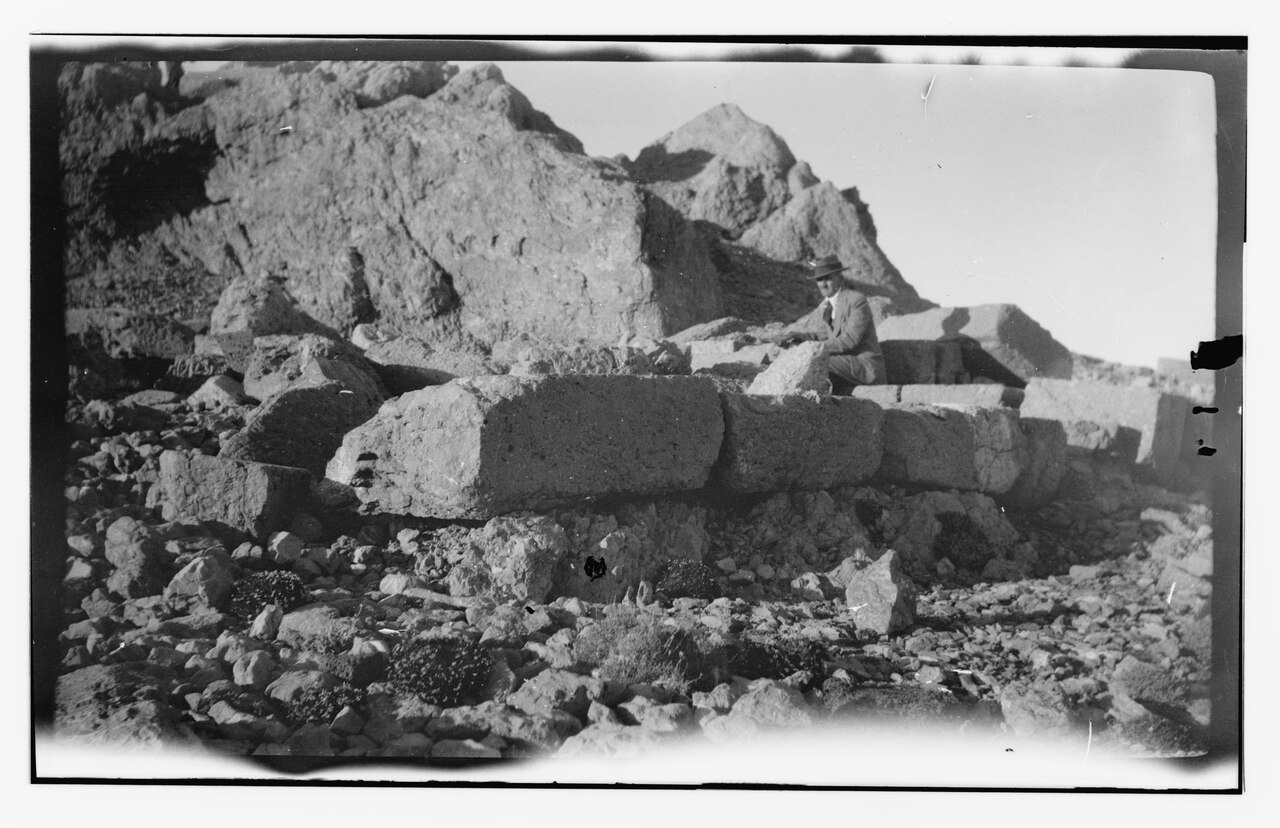
DOCUMENTED — the wives, the giants, and the teachings (chs. 7–8). The Watchers take wives, and the women bear “great giants, whose height was three thousand ells” in Charles's text — a figure the manuscript tradition itself varies. The giants consume the produce of men's labour; when men can no longer sustain them, they turn on mankind:
“The giants turned against them and devoured mankind. And they began to sin against birds, and beasts, and reptiles, and fish, and to devour one another's flesh, and drink the blood. Then the earth laid accusation against the lawless ones.”
DOCUMENTED. Interleaved is the teaching: “charms and enchantments, and the cutting of roots,” and acquaintance with plants. Chapter 8 distributes the curriculum by name, Asael at its head:
Asael “taught men to make swords, and knives, and shields, and breastplates, and made known to them the metals of the earth and the art of working them, and bracelets, and ornaments, and the use of antimony, and the beautifying of the eyelids, and all kinds of costly stones, and all colouring tinctures. And there arose much godlessness, and they committed fornication, and they were led astray, and became corrupt in all their ways.”
DOCUMENTED. Shemihazah taught enchantments and root-cuttings; Armaros the resolving of enchantments; Baraqijal astrology; Kokabel the constellations; Ezeqeel the clouds; Araqiel the signs of the earth; Shamshiel the signs of the sun; Sariel the course of the moon. Two corruptions stand side by side in the account and are never separated in it — mixture (the giants) and instruction (the arts taught before their time) — and the judgment answers both. Read beside this class: When the Tablets Speak.
DOCUMENTED — the cry and the plea refused (chs. 9–16). The archangels — Michael, Uriel, Raphael and Gabriel — carry the earth's accusation upward: blood shed on the earth, the earth made waste and corrupt, the souls of men making their suit. Sentence is pronounced (below), and Enoch is made its herald. The Watchers ask him to intercede and to write out their petition. He writes it, reads it by the waters of Dan, and receives the answer in a vision of the throne. The answer is refusal, and its reasoning is the text's own theology of the fall:
“You should intercede for men, and not men for you… Wherefore have ye left the high, holy and eternal heaven, and lain with women, and defiled yourselves with the daughters of men and taken to yourselves wives, and done like the children of earth, and begotten giants as your sons? … Ye were holy, spiritual, living the eternal life.”
DOCUMENTED — what became of the giants (ch. 15). The same vision settles the giants' afterlife:
“And now, the giants, who are produced from the spirits and flesh, shall be called evil spirits upon the earth, and on the earth shall be their dwelling. Evil spirits have proceeded from their bodies; because they are born from men, and from the holy Watchers is their beginning and primal origin; they shall be evil spirits on earth… And the spirits of the giants afflict, oppress, destroy, attack, do battle, and work destruction on the earth, and cause trouble.”
DOCUMENTED — the judgment, in kinds (ch. 10). Not one sentence but four, each fitted to its object. Against Asael: Raphael is to bind him hand and foot and cast him into the darkness, through an opening in the desert “which is in Dudael,” jagged rocks heaped over him, until the day of the great judgment, when he is cast into the fire — and the earth healed of the corruption his teaching made, “through all the secret things that the Watchers have disclosed and have taught their sons.” Against the giants: Gabriel is to send them “one against the other that they may destroy each other in battle” — the giants die by one another's hands, in sight of their fathers. Against Shemihazah and his company: Michael is to bind them “for seventy generations in the valleys of the earth, until the day of their judgement” — bound, not executed; reserved. For mankind: Uriel is sent to Noah to warn him that a deluge is about to destroy the whole earth, and to teach him how he may escape, “that his seed may be preserved for all the generations of the world.” Read beside this class: The Flood Traditions · Before All Worlds.
DOCUMENTED — Enoch's journeys (chs. 17–36). The book's second half is travel: the prison of the seven fallen stars, bound and burning; the chasm and the fire at the ends of the earth; the mountain of the throne and the fragrant tree reserved for the righteous; the accursed valley of judgment; paradise and the tree of life; and chapter 22 — the hollow places where the souls of the dead wait, separated, until the great judgment. The journeys are the sentence made geography: the places of binding are places Enoch is taken to see.
§3 — JUBILEES' RETELLING — SENT TO TEACH
DOCUMENTED. The Book of Jubilees — a Hebrew work of the second century BC, preserved whole, like 1 Enoch, in Ge'ez, and in fragments at Qumran — retells the Watchers with one decisive difference of frame. In Jubilees 4 the descent begins as a mission: in the days of Jared “the angels of God descended on the earth, those who are named the Watchers, that they should instruct the children of men, and that they should do judgment and uprightness on the earth.” The Watchers of Jubilees were sent to teach — lawfully, on commission — and their fall is a fall from an assignment.
DOCUMENTED. Jubilees 5 then follows Enoch's plot: wives taken, sons who were giants, “lawlessness increased on the earth and all flesh corrupted its way,” the sword sent into the giants' midst so that each slays his neighbour, the fathers witnesses of the destruction, and the Watchers “bound in the depths of the earth for ever, until the day of the great condemnation.”
DOCUMENTED — the demons, and the tenth part (Jubilees 10). After the Flood, the demons — the spirits of the giants — lead astray, blind and slay the sons of Noah. Noah prays against them, calling the Watchers “the fathers of these spirits.” The order is first given to bind them all. Then Mastema, chief of the spirits, petitions:
“‘Lord, Creator, let some of them remain before me, and let them hearken to my voice, and do all that I shall say unto them; for if some of them are not left to me, I shall not be able to execute the power of my will on the children of men; for these are for corruption and leading astray before my judgment, for great is the wickedness of the children of men.’ And He said: ‘Let the tenth part of them remain before him, and let nine parts descend into the place of condemnation.’”
DOCUMENTED. Nine parts bound; a tenth part left under Mastema — Jubilees' explanation, at text level, for a continuing demonic presence that is permitted, limited and numbered. In the same chapter the angels teach Noah “all their medicines” — healing lore against the diseases the demons work — and Noah writes it in a book and gives it to Shem. The two retellings side by side: in Enoch the Watchers descend on their own sworn initiative and the giants' spirits remain wholesale; in Jubilees they descend sent, and after the Flood nine-tenths of the spirits are bound. The core is one account in two tellings, and the differences are the tellings' own, printed unharmonised.
§4 — THE STRUCTURE, IN ONE VIEW
DOCUMENTED. The whole shape of the account, element by element:
- Heavenly beings come down — two hundred Watchers descend on Mount Hermon in the days of Jared, by sworn conspiracy (Enoch 6); in Jubilees, sent to instruct, and fallen from the commission (Jubilees 4).
- They take human wives — against their station: “ye were holy, spiritual, living the eternal life” (Enoch 15).
- Hybrid offspring are born — the giants, “produced from the spirits and flesh” (Enoch 7; 15); “mighty men which were of old” (Genesis 6:4).
- They teach forbidden arts — weapons, cosmetics, sorcery, root-cuttings, and the signs of sun and moon (Enoch 7–8); the “secret things that the Watchers have disclosed” corrupt the whole earth (Enoch 10).
- The offspring corrupt the earth — devouring mankind, sinning against every creature, drinking blood (Enoch 7), until “the earth laid accusation against the lawless ones.”
- Judgment is measured out in kinds — Asael bound in Dudael; the giants destroy one another; the Watchers bound until the judgment (Enoch 10; Jubilees 5; 2 Peter 2:4; Jude 6).
- Something of the offspring remains on earth — the giants' spirits, “evil spirits upon the earth” (Enoch 15–16); in Jubilees, a tenth part left, nine parts bound (Jubilees 10).
- The Flood closes the account — Noah warned, his seed preserved “for all the generations of the world” (Enoch 10).
§5 — THE NATIONS OF GIANTS IN THE TEXTS
DOCUMENTED — at text. Genesis 6:4's “and also after that” opens into a small, precise geography: named peoples of great stature, remembered by the peoples around them under several names. The Rephaim are the umbrella name — a people of giants in the land before Israel (Deuteronomy 2:11, 20). The Emim dwelt in Moab in times past, “a people great, and many, and tall, as the Anakims… but the Moabites call them Emims” (Deuteronomy 2:10–11). The Zamzummim are the same kind of people under the Ammonites' name: “giants dwelt therein in old time; and the Ammonites call them Zamzummims; a people great, and many, and tall, as the Anakims” — and the text records that Yahweh destroyed them before the Ammonites, who dwelt in their stead (Deuteronomy 2:20–21). The Anakim are the giants of Hebron, before whom the spies reported “we were in our own sight as grasshoppers” (Numbers 13:33), where the chain is stated in one line: “the sons of Anak, which come of the giants.”
DOCUMENTED — Og of Bashan, at his measure. The last of the line is given a measurement. Deuteronomy 3:11:
“For only Og king of Bashan remained of the remnant of giants; behold, his bedstead was a bedstead of iron; is it not in Rabbath of the children of Ammon? nine cubits was the length thereof, and four cubits the breadth of it, after the cubit of a man.”
DOCUMENTED. Nine cubits by four — roughly four metres by two on any reckoning of the cubit — is the canon's one measured giant: not a height claimed for the man (a bedstead is furniture, and royal furniture proclaims), but an artefact the text points to as still inspectable in Rabbah in its day. The texts carry the nations of giants as peoples with lands, predecessors and successors, displaced in the record in turn — and Og as their remnant's end in battle at Edrei. Read beside this class: Giants and Great Doors.
§6 — THE APKALLU — MESOPOTAMIA'S SEVEN SAGES
DOCUMENTED — in the texts. The older civilisation of Mesopotamia kept its own account of where civilisation came from, and it too begins before a flood, with teachers who were not simply men. The apkallu are the seven antediluvian sages: culture-bringers of the time before the Flood, each attached in the king-and-sage lists to one of the antediluvian kings, credited with the arts and order of civilisation — the plans of heaven and earth, wisdom, craft, incantation and kingship's counsel. The lists name them, with variation between copies — the variation is part of the record: Uanna — Greek tradition's Oannes — “who completed the plans of heaven and earth”; Uannedugga, “endowed with comprehensive understanding”; Enmedugga; Enmegalamma; Enmebulugga; Anenlilda, “the conjurer of the city of Eridu”; and seventh, Utuabzu, “who ascended to heaven.” The incantation series Bīt mēseri calls them “the seven sages, the pure purādu-fishes of the sea, who originated in the river, who control the plans of heaven and earth” — sages of the Apsu, the deep of Ea, god of wisdom, whose city was Eridu. The Babylonian priest Berossus (3rd century BC) carries the first of them, Oannes, to the Greek world as a fish-formed teacher who rose from the sea by day to teach men letters, sciences and arts. After the Flood the tradition continues diminished: four later apkallu of mixed nature — one said to be only two-thirds apkallu — remembered in some texts also for transgressions that angered the gods, and then wholly human counsellors.
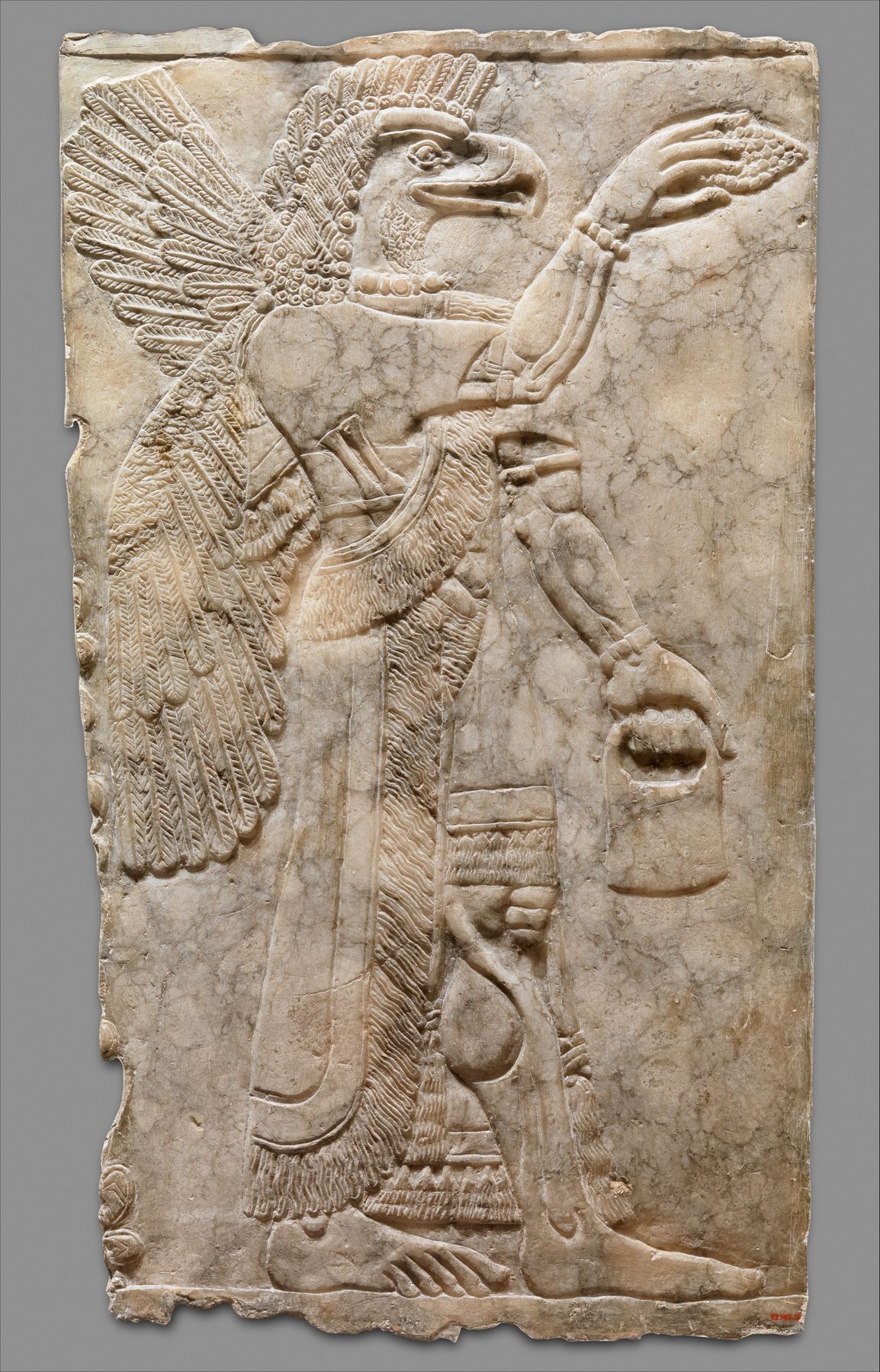
DOCUMENTED — in the palace reliefs. In the Northwest Palace of Ashurnasirpal II at Nimrud (r. 883–859 BC) the walls carry winged protective figures in procession — eagle-headed and human-headed, wearing the horned crown of divinity, holding bucket and cone, flanking the king and the stylised sacred tree; figurines of the same beings, in sets named by ritual texts, were buried under doorways and floors to guard a house. Fish-cloaked figures carry the sages' origin in the Apsu into visible form: the sage in the skin of a fish.
DOCUMENTED as scholarship; DEBATED as derivation — the comparison. The comparison between the apkallu and the Watchers is a standing subject of the scholarly literature on both corpora. The correspondences it works on are structural and specific: antediluvian teachers — both traditions place non-human or part-human teachers before the Flood as the source of arts mankind did not develop unaided; mixed nature — the postdiluvian apkallu are part-human, and the Mesopotamian tradition is not uniformly benign about its own sages, some of whom transgress and anger the gods; cosmic and mantic knowledge — astrology, omens, incantation and the ordering of the heavens belong to both figures' portfolios; and the seventh figure — Utuabzu “ascended to heaven,” and the seventh antediluvian king, Enmeduranki, was taken into the divine assembly and shown the heavenly tablet — set by the comparative literature beside Enoch, seventh from Adam, taken and shown the tablets. Against derivation stand the differences, and they are not small: the apkallu in their own texts are legitimate — sent and authorised, civilisation's founders, invoked for protection for two thousand years; the Watchers in theirs are transgressors, their teaching classed by the text itself as corruption. One scholarly line argues deliberate inversion — authorised sages recast as illegitimate teachers, with Enoch raised above both; another reads shared ancient stock rather than borrowing. Whether Genesis 6 and the Book of Watchers adapt the apkallu tradition, invert it, or draw on a common reservoir is DEBATED. What is DOCUMENTED is narrower and sufficient: two neighbouring civilisations, in writing, each remembered the time before the Flood as a time when knowledge came down from above through beings who were not ordinary men — and one of them carved those beings on its palace doors.
§7 — THE BOOK'S ROAD BACK — SURVIVAL, WITNESSES, DATES
DOCUMENTED. The Book of Watchers was widely read in the Second Temple world; Jude quotes the book's prophecy; early Christian writers cite it as scripture-grade authority. Then, in the West and most of the East, it stopped being copied, and the complete book was lost to those literatures, surviving in Greek only in fragments and quotations. In Ethiopia alone the whole book survived, in Ge'ez, inside the canon of the Ethiopian Orthodox Tewahedo Church — 1 Enoch and Jubilees both — copied and preached through the entire period of its absence elsewhere. Every complete modern edition descends from Ethiopian manuscripts.
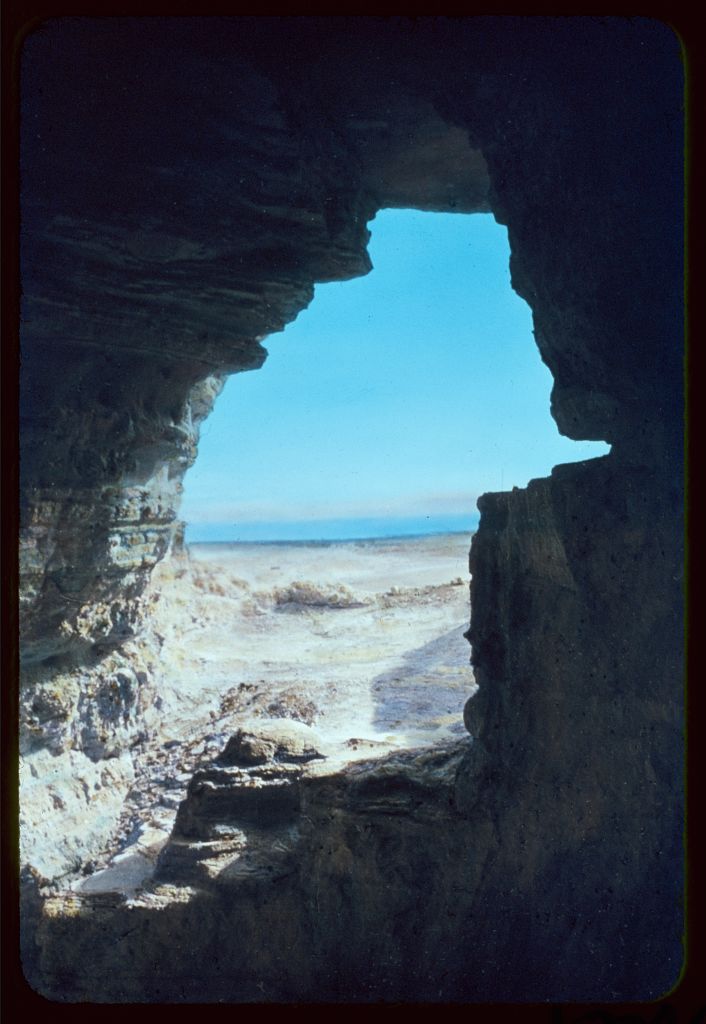
DOCUMENTED. In AD 1773 the Scottish traveller James Bruce brought three Ge'ez copies of the book from Ethiopia to Europe. In AD 1821 Richard Laurence, Regius Professor of Hebrew at Oxford, published the first English translation. R. H. Charles's English editions — 1893, the Ethiopic text and translation of 1906, and the translation of 1912 that became the standard English Enoch of the twentieth century, and the translation base of this Collection's Enoch master — set the book into modern scholarship. In the mid-twentieth century the circle closed: Cave 4 at Qumran yielded Aramaic fragments of Enoch older than any Ge'ez copy by well over a millennium. Read beside this class: The Chronology.
The dates at their classes. The Book of Watchers composed: DEBATED, scholarly consensus third century BC, some arguing older strata. Jubilees composed: second century BC (commonly c. 170–150 BC). Aramaic Enoch at Qumran: DOCUMENTED — the earliest copy of the Book of Watchers dated by its editor, J. T. Milik, to c. 200–150 BC; all Qumran Enoch copies are Aramaic, and the Book of Parables (chs. 37–71) is the one major section not found there. The surviving complete Ge'ez copies are 15th-century and later copies of an ancient translation. A date of 1917 sometimes attached to “Charles's Enoch” was not verified against any edition record in the research behind this class and is not carried; Charles's standard translation is 1912.
§8 — THE MODERN CIRCULATION — A SIGNPOST
In the present century the Watchers have returned to mass circulation outside the academies and the churches: in video lectures, courses and social-media teaching, the descent, the giants and the forbidden arts are retold at scale, collated with the giant nations, with translation lineages, and with the Mesopotamian material — genuine textual substance standing beside systems the record does not support, each element to be taken at its own class, as this class has taken the texts.
OWNER'S TEACHING, governing where the visitors' worlds are treated. The modern circulation names the star systems the beings are said to come from, and worlds beyond this one stand at the centre of its geography. The owner's teaching, at this class's head, answers it at both its edges: other worlds beyond our own exist — the saying of the Infancy Gospel of Thomas, treated whole in the companion class Before All Worlds, is his ground for it — and Yeshua is before all worlds: no world, and nothing from any world, precedes or outranks Him. A visitor's world, whatever it is said to be, stands inside that order, never above it. The identification under which the owner reads the whole field stands at this class's head as OWNER'S TEACHING, unmerged. The signpost points back to the books — Genesis's four verses, Enoch whole, Jubilees beside it — which any reader may now hold entire, in the open, in English. What was done is written; what was hidden is recovered; what it means is the reader's work, at the classes printed here.
OWED / NOT CARRIED, in brief
An honest gap stands as a gap. Nothing in this register is filled by inference.
- A line-by-line collation of Charles against the current critical editions is owed before any typeset quotation programme; quotations here are Charles's public-domain text as carried in the Collection's held master tradition.
- The “three thousand ells” of 1 Enoch 7 stands as Charles renders the received text; the manuscript variants of the giants' height were noted, not collated.
- Og's bedstead as artefact: the text points to it at Rabbah; no surviving object is identified with it, and none is claimed here.
- The apkallu lists vary by copy in names and order; one received list-form is printed at §6, and a full synoptic collation is owed.
- Whether the relief figures “are” the apkallu stands at the Museum's own caution, §6 — a suggested level of symbolism, not a settled identification.
Sources
Held witness (David's files): his held edited master of 1 Enoch (enoch_master_v02.txt, Charles translation base — a canonical master in the Collection) and of Jubilees (jubilees_master_v03.txt).
Standard editions and sources named in the text: Genesis 6, 9 · Numbers 13 · Deuteronomy 1–3 · Job 1–2, 38 · 2 Peter 2 · Jude · 1 Enoch (Book of Watchers, chs. 1–36), trans. R. H. Charles (1893; Ethiopic edition 1906; translation 1912) · Jubilees, trans. R. H. Charles · Berossus, Babyloniaca, fragments · Bīt mēseri incantation series · Metropolitan Museum of Art, collection records for the Nimrud relief panels (objects 32.143.12, 32.143.6), Open Access · J. T. Milik, The Books of Enoch: Aramaic Fragments of Qumrân Cave 4 (1976) · James C. VanderKam, Enoch and the Growth of an Apocalyptic Tradition (1984) · Helge S. Kvanvig, Roots of Apocalyptic (1988) · Amar Annus, “On the Origin of Watchers” (2010).
Images: Mount Hermon — Library of Congress, Matson Collection, 1925 (public domain in the United States); SHA-256 8fb16c920ca5ad61d580f43ca7b01b76dc80eb87c6b7cdfaba77a457c87c8bbe · 208,097 bytes. Nimrud relief panel — Metropolitan Museum of Art, object 32.143.12 (Open Access, public domain verified on the Museum's record and API); SHA-256 96b4e9d007188f40942a3805698b1fb27dc73e2598c932f15fcfe1bfff7b5d71 · 2,882,976 bytes. Cave at Qumran — Library of Congress / Matson (Wikimedia Commons, CC0); SHA-256 b82f2259a63574b9935bdac487d4b268eaa4c2eb8c4e871e7eb987e3bf355384 · 90,219 bytes. All filed locally at /images/watchers-*; no hotlinking.
Read beside this class: When the Tablets Speak · The Flood Traditions · Before All Worlds · Giants and Great Doors · The Heavens They Knew · Portals and CERN · The Chronology
Record: THE_WATCHERS_IN_THE_TEXTS_2026-10-28.md (study_materials/world_history) — classes carried unchanged; the texts read whole, the comparison at its scholarly weight.