Indigenous · History Classes · Grades 10–13 · College · University
The Heavens They Knew — Enoch's Calendar, Babylon's Tablets, and the Star Debates
History Class · Level band: Grades 10–13 · College · University
English edition — the language editions of the history classes are outstanding and will follow the site’s translation pattern; none is fabricated here.
OWNER'S TEACHING — the head of this class
Class: OWNER'S TEACHING. David's teachings (2026-10-28), standing as OWNER'S TEACHING, never flattened into the record:
“He may know the star system they came from but I know that they are fallen angels.” (2026-10-28 20:53)
“I also know from the Infancy Gospel of Thomas that Yeshua was said He is before all worlds — this informs me that there are other worlds beyond our own.” (2026-10-28 20:54, restating his 19:29 teaching)
The second teaching carries its second edge with it: other worlds beyond our own exist, AND Yeshua is before all worlds — no world, and nothing from any world, precedes or outranks Him. The education's treatment of other worlds stands in the companion class, Before All Worlds, and this class hangs from the text and the teaching together wherever the visitors' worlds are treated (§4). The classes used throughout this class are: DOCUMENTED (a text or record says it, at the source named) · DEBATED (the record carries both sides) · CLAIM (asserted, not evidenced) · OWNER'S TEACHING (David's own teaching, in his words, governing where he has ruled).
§1 — ENOCH'S OWN ASTRONOMY: THE REVEALED CALENDAR AND THE STOLEN SIGNS
DOCUMENTED. 1 Enoch carries two accounts of heavenly knowledge, and the same book holds both. In the Astronomical Book, also called the Book of Luminaries (1 Enoch 72–82), the angel Uriel shows Enoch the order of the luminaries: the sun rises through six gates in the east and sets through six gates in the west, spending thirty days at each gate; the day lengthens and shortens through the year in measured parts — nine and nine at the equinoxes, twelve to six and six to twelve at the solstices. Twelve months of thirty days make 360, and four further days, set at the ends of the third, sixth, ninth and twelfth months, complete the year: 364 days, four quarters of 91 days, fifty-two weeks exactly (1 En 72; 74:12; 82).
DOCUMENTED. The moon is given its own law beside the sun's (1 En 73–74): its light waxes and wanes in halves through its course, and its year falls short of the sun's. The book insists the count must not be broken: those who omit the four days err from the reckoning of the whole year, the seasons shift, and the feasts fall out of their appointed times (1 En 75; 82:4–6). To keep the count is to meet the feasts at the time appointed; to lose the count is to lose the meeting.
DOCUMENTED — composition, at its class. Aramaic fragments of the Astronomical Book were found at Qumran, and the work is among the oldest strata of 1 Enoch, commonly dated to the 3rd century BC or earlier. DEBATED: the exact century of composition. Its standing in the owner's canon, in the Charles-based master, is not debated.
DOCUMENTED. Set in the text's own order, the accusation stands earlier in the same book. In 1 Enoch 8, the fallen Watchers teach what was not given to be taught: Azazel teaches the making of swords, knives, shields and breastplates, the metals of the earth and the art of working them, bracelets, ornaments, antimony for the eyelids, costly stones and colouring tinctures; Semjaza teaches enchantments and root-cuttings; Armaros the resolving of enchantments; Baraqijal astrology; Kokabel the constellations; Ezeqeel the knowledge of the clouds; Araqiel the signs of the earth; Shamsiel the signs of the sun; and Sariel the course of the moon — “and as men perished, they cried, and their cry went up to heaven” (1 En 8:1–3, Charles translation).
The heavens, in Enoch's telling, were therefore known twice: once by revelation — an ordered calendar, given through Uriel, by which the year is kept — and once by theft — signs of sun, moon and stars handed down by the fallen, named in the book as corruption. Both stand in this class, in the order the book gives them. Read beside this section: The Watchers in the Texts.
§2 — BABYLON: VENUS KEPT, THE SKY CATALOGUED, THE ZODIAC MADE
DOCUMENTED. Babylon's astronomy is the longest continuous sky-record of the ancient world, and it begins in observation kept across generations. The Venus tablet of Ammisaduqa — Tablet 63 of the omen series Enuma Anu Enlil — preserves the first and last visibilities of Venus, its heliacal risings and settings, recorded in lunar dates across 21 years of the reign of Ammisaduqa, fourth king after Hammurabi. The observations belong to the 17th century BC (Middle Chronology; the absolute chronology is DEBATED between high, middle, low and ultra-low schemes); the copies that survive are 7th-century BC tablets, the best known (K.160, British Museum) recovered from the library at Nineveh. A planet's appearances, written down year after year and still being copied a thousand years later: that is what a sky-archive looks like.
DOCUMENTED. The MUL.APIN tablets — named from their opening words, “the Plough Star” (the Pleiades) — gather the sky into a catalogue. Compiled c. 1000 BC (surviving copies early 7th century BC), they list the stars and constellations in three paths across the sky — the northern path of Enlil (33), the equatorial path of Anu (23), the southern path of Ea (15) — give the heliacal rising dates of 34 stars against an ideal 360-day year, set out which stars rise and culminate together, and name the 17 or 18 constellations in the path of the Moon, among them every constellation that would later stand in the twelve-sign zodiac: the Bull of Heaven, the Great Twins, the Crab, the Lion, the Furrow, the Scales, the Scorpion, Pabilsag the Archer, the Goat-Fish, the Great One.
DOCUMENTED. From that lunar path the Babylonians made the zodiac itself: in the 5th century BC the eighteen were winnowed to twelve signs of thirty degrees each — the frame later astronomy still inherits. Around the catalogues stood the omen literature, Enuma Anu Enlil at its head: celestial phenomena read as signs for king and land. The observations are DOCUMENTED; the readings of them as portents are the literature of their culture, taught as such. Read beside this section: The Tablets Speak · Chronology.
§3 — EGYPT: THE DECANS, SOTHIS, AND THE YEAR OF 365 DAYS
DOCUMENTED. Egypt timed the night by stars. The decans were 36 star-groups whose risings, each ten days apart, marked the night hours and divided the year: 36 × 10 = 360 days, with five added days making the 365-day civil year — the calendar Rome would later take up and reform. The decans appear first on coffin lids of c. 2100–1800 BC, in the diagonal star tables that served as star clocks, and later on tomb and temple ceilings. Which modern stars correspond to which decans is in many cases DEBATED — the names survive more securely than the identifications.
DOCUMENTED. At the head of the decans stood Sirius — Egyptian Sopdet, Greek Sothis. After some seventy days hidden in the sun's glare, its heliacal rising, its first appearance in the dawn, coincided with the coming of the Nile flood and marked the New Year. One star's return anchored a nation's agriculture, calendar and festival cycle. Because the 365-day civil year drifts against the solar year, the two realign only after about 1,460 years — the Sothic cycle, which remains a working tool of Egyptian chronology.
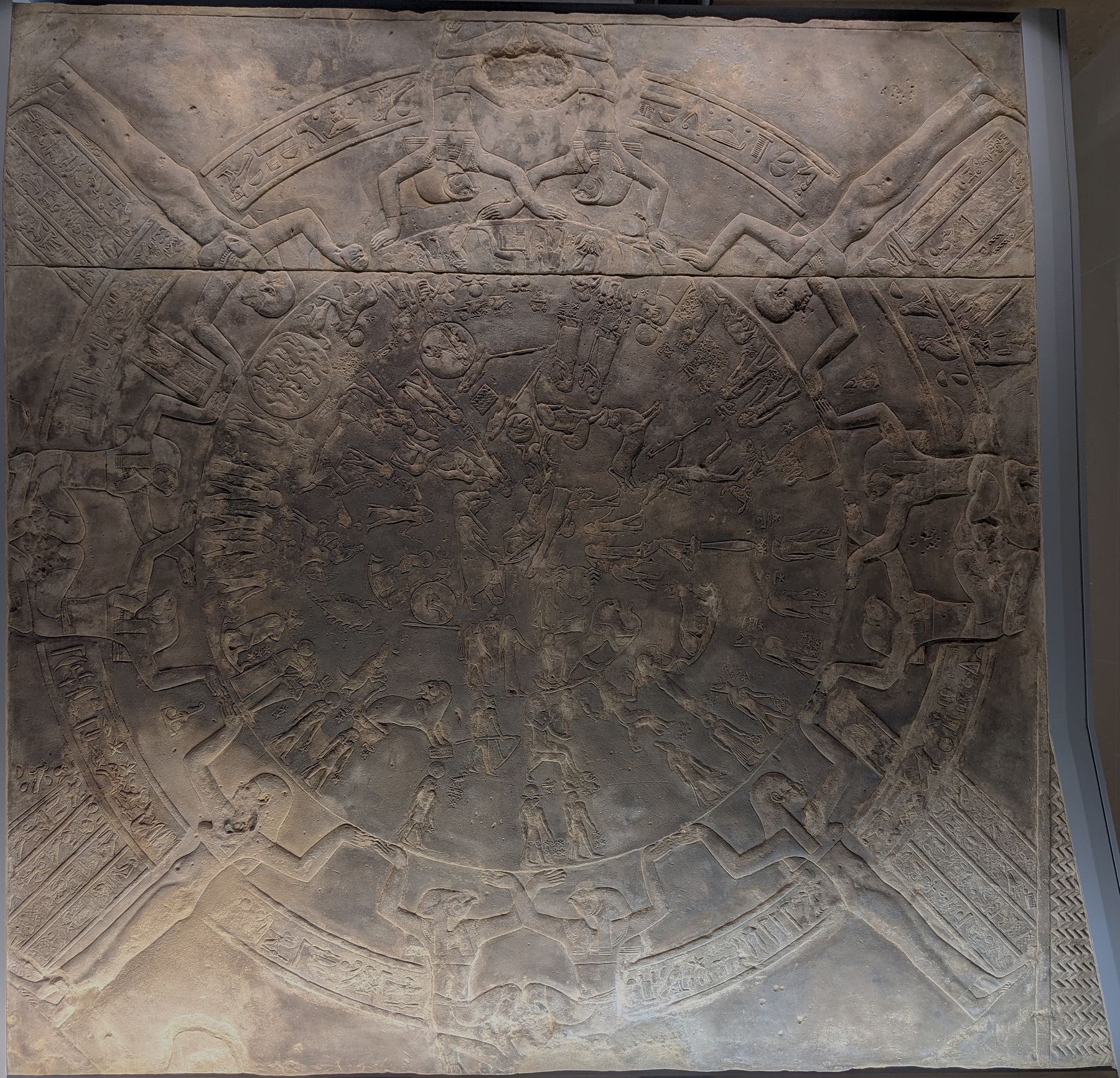
DOCUMENTED. The monumental orientations belong to the same discipline at their documented level: the Great Pyramid's alignment to true north, accurate to a few minutes of arc, achieved by stellar observation without a magnetic compass. And in the late temple at Dendera (c. 50 BC) the two skies meet in one carving: the circular zodiac sets the Babylonian twelve signs inside an Egyptian frame, the 36 decans around its rim.
§4 — THE DOGON AND SIRIUS: A DEBATE IN THREE STATIONS
DEBATED throughout. This section teaches what a debate looks like from inside: three stations, each at its exact weight, and no verdict borrowed from any of them.
Station one — the account as published, 1950. DOCUMENTED as a publication; its content DEBATED. A French ethnographic article of 1950, reporting fieldwork among the Dogon people of Mali in 1946–1950 (with related material from neighbouring peoples), published the account of initiated elders: Sirius — sigu tolo — has a companion, po tolo, the Digitaria star: the smallest and heaviest of stars, made of a metal heavier than iron, invisible to the eye, circling Sirius in an elliptical orbit of fifty years. A second companion, emme ya tolo, was also described. The astronomical facts against which the account is measured are themselves DOCUMENTED: Sirius B is a white dwarf, invisible to the naked eye, first inferred in 1844, first seen telescopically in 1862, with an orbital period of about 50.1 years and a density no naked-eye culture could measure. No third companion, Sirius C, has ever been confirmed.
Station two — the popularisation, 1976. DOCUMENTED as a publication; its doctrine CLAIM. In 1976 a popular book took the ethnographic account out of the journals and made it a cornerstone of the visitors' literature: the Dogon knowledge, it argued, could only have come from visitors from the Sirius system itself, and it wove the account together with Egyptian and Mesopotamian material into a single ancient-contact system. From that book onward, the Dogon case circulated worldwide as the strongest exhibit for ancient visitors. The book's existence and influence are DOCUMENTED; its visitors are CLAIM. Where those visitors' worlds are treated, this education's frame stands in Before All Worlds: the text and the owner's teaching together.
Station three — the restudy, 1991. DOCUMENTED as a publication. An anthropologist who had lived and worked among the Dogon for a decade published a field evaluation in 1991. He reported that the Sirius lore could not be found as described: that Sirius is a double star was unknown; the companion's mass and orbital period were absent; informants disagreed among themselves about which star sigu tolo even names — and agreed, he reported, that they had learned about the star from the original ethnographer. His documented alternative is contamination: Sirius B was European public knowledge by the 1930s (an 1893 French astronomical expedition had spent weeks in the region), and knowledge can travel into a tradition through contact, questioning and prompting — including the ethnographer's own, who had studied astronomy and carried star maps in the field — without any visitor from the stars.
The three stations do not cancel each other into a shrug. They stand in order: an account published (1950), a doctrine built on it (1976), a restudy that could not replicate it (1991). A claim about the heavens is only ever as strong as the record that carries it.
OWNER'S TEACHING, governing this section, unmerged. David's identification stands in his words:
“He may know the star system they came from but I know that they are fallen angels.”
§5 — THE ANTIKYTHERA MECHANISM: THE MEASURED RULER
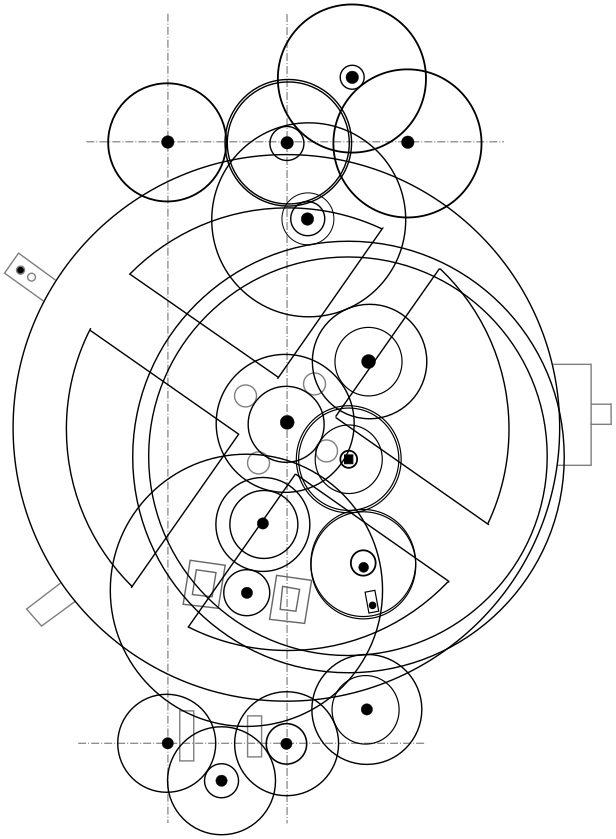
DOCUMENTED. In 1901 sponge divers working a Roman-era shipwreck off the island of Antikythera recovered, among statues and pottery, a corroded lump of bronze. It proved to be a geared cosmos: at least thirty bronze gears surviving in 82 fragments (more in reconstruction), housed in a wooden case about the size of a mantel clock, inscribed in Greek, built c. 150–100 BC (a start-date of 205 BC for its eclipse cycle has been proposed; the wreck itself is dated c. 80–60 BC — the exact year of construction is DEBATED within that frame). It is held today in the National Archaeological Museum, Athens.
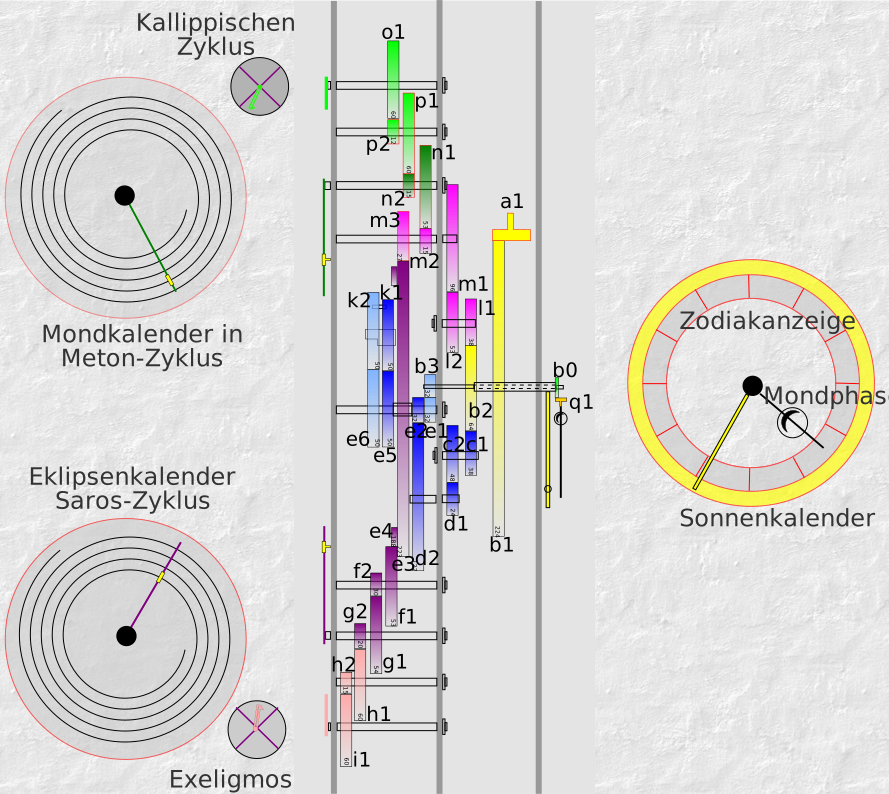
DOCUMENTED. Turned by a hand crank, the mechanism displayed the motions of sun and moon, the moon's phases, and — on spiral dials at its back — the 235-month Metonic calendar and the 223-month Saros eclipse cycle, predicting lunar and solar eclipses by Babylonian arithmetic cycles, with a pin-and-slot gearing that reproduces the moon's varying speed — Hipparchos's theory of the lunar anomaly, realised in bronze. A subsidiary dial tracked the four-year cycle of the Panhellenic games. Nothing of comparable geared complexity is documented again for more than a thousand years.
This is the measured ruler of the whole class. The ancient world demonstrably could build this — and it is built of exactly what the record elsewhere shows: Babylonian period-relations, Greek geometry, patient observation over centuries. Every claim of impossible ancient knowledge is to be measured against it: the mechanism is astonishing, and it is entirely human, entirely documented, gear by gear.
§6 — KANEH-BOSEM: THE HERB IN THE SANCTUARY'S RECORD
DOCUMENTED — the text. Exodus 30:23 gives the recipe of the holy anointing oil: myrrh, cinnamon, qaneh-bosem — rendered “sweet calamus” or “aromatic cane” in the standard translations — and cassia, in olive oil. The ingredient stands in the recipe at DOCUMENTED level; its botanical identity does not. Read beside this section: The Table.
DEBATED — the word. In 1936 an anthropologist proposed, on comparative Semitic linguistics, that kaneh-bosem — kaneh, reed/cane, + bosem, aromatic — is cannabis: the fused form kanabos/kannabus is attested in later Hebrew sources, and the resemblance to the Scythian-Greek kannabis is the heart of the argument. The standard lexica have not followed the proposal: they read an aromatic reed or cane (calamus, Acorus calamus, or a related aromatic grass). The identification therefore stands DEBATED — a serious proposal, ninety years old, contested by the reference works, settled by neither side.
DOCUMENTED — the altar. In 2020, residue analysis was published from the Judahite shrine at Tel Arad (8th century BC): on the smaller of two limestone altars at the entrance to the shrine's holy of holies, analysts identified cannabinoids — THC, CBD and CBN — with terpenes indicating cannabis inflorescences burned with animal dung as fuel; on the larger altar, frankincense burned with animal fat. Two independent laboratories, peer-reviewed publication. Cannabis was burned in worship in the kingdom of Judah. That is DOCUMENTED.
Neither finding inflates the other: the altar does not prove the word — Arad shows cannabis in a Judahite sanctuary, not that qaneh-bosem in Exodus 30 names it — and the word's debate does not diminish the altar. The herb stands in the sanctuary's record at exactly its weights.
§7 — THE FRAME: WHAT WAS KNOWN, AND WHAT HAS BEEN CLAIMED
What the ancient world demonstrably knew of the heavens can be listed without exaggeration, and the list is long: a planet's risings kept across a reign and copied for a millennium; the whole sky catalogued into paths and a lunar road that became the zodiac; a night measured by 36 star-groups and a year of 365 days hung on one star's dawn return; a calendar of 364 days argued as revelation and kept against the Temple's own reckoning; and, at the end of the story, the cycles of sun, moon and eclipse cut into bronze gears that still turn in reconstruction. None of it required visitors. All of it required watchers of another kind: people who watched the sky for centuries and wrote down what they saw.
What has been claimed for that world since is also part of the record, and this class has carried the claims at their class — a companion star's lore that a restudy could not find, a doctrine of visitors built upon it, a contested word in an oil recipe. Measured against the ruler of §5 and the archive of §2, the claims sort themselves: what the texts and tablets and gears can carry, stands; what they cannot, remains claim. The heavens they knew were real. They are enough.
OWNER'S TEACHING, closing the class, unmerged.
“I also know from the Infancy Gospel of Thomas that Yeshua was said He is before all worlds — this informs me that there are other worlds beyond our own.”
Other worlds beyond our own exist — and Yeshua is before all worlds. No world, and nothing from any world, precedes or outranks Him. See Before All Worlds.
OWED / NOT CARRIED, in brief
An honest gap stands as a gap. Nothing in this register is filled by inference.
- MUL.APIN / Venus tablet photograph — OWED. No photograph of either tablet could be verified as strictly public domain or CC0 on its holding file page at build time (British Museum photography on Commons is commonly CC BY-NC-SA or CC BY, neither sufficient under this strand's standard). No image is carried; none is hotlinked.
- Antikythera Fragment A photograph — OWED in photographic form. The surviving photographs of the fragments on Commons are CC BY / CC BY-SA, not PD/CC0. This page carries instead two verified diagrams — a public-domain schematic and a CC0 gear-train reconstruction — labelled as diagrams, not photographs (§5).
- Tel Arad altar photograph — OWED on the same licence standard.
- Enoch Astronomical Book, fragment-level census (the Aramaic fragments' inventory, the Ge'ez transmission in full) is summarised at §1, not catalogued; a census is owed before any typeset edition work.
- Dendera rectangular zodiac and temple orientation survey data are characterised at documented level, not reproduced.
Sources
Held witness (David's files): his held master of 1 Enoch (Charles translation base), ch. 8 and chs. 72–82 (the Astronomical Book / Book of Luminaries).
Standard editions and sources named in the text: 1 Enoch 8; 72–82 (Charles translation) · Exodus 30:23 · the Venus tablet of Ammisaduqa (Enuma Anu Enlil Tablet 63; K.160, British Museum; Reiner & Pingree edition, 1975) · MUL.APIN tablets (Hunger & Pingree edition) · Egyptian decans and diagonal star tables; the Sothic cycle; the Dendera zodiac (Louvre D 38 / E 13482, c. 50 BC) · the 1950 ethnographic account of the Dogon Sirius system (Journal de la Société des Africanistes 20, 1950) · the 1976 popularisation of that account · the 1991 Dogon restudy (Current Anthropology 32, 1991) · Freeth et al., Nature 444 (2006) and Scientific Reports 11 (2021), on the Antikythera mechanism; Carman & Evans (2014) on its epoch · the 1936 kaneh-bosem identification · Arie, Rosen & Namdar, “Cannabis and Frankincense at the Judahite Shrine of Arad,” Tel Aviv 47 (2020).
Images: Dendera zodiac — photograph by Shonagon (2022), Wikimedia Commons, CC0 1.0 · Antikythera gear-train reconstruction diagram (2012), Wikimedia Commons, CC0 1.0 · Antikythera schematic (2009), Wikimedia Commons, public domain. Full census with hashes stands in the research file.
Read beside this class: The Watchers in the Texts · Before All Worlds · The Tablets Speak · The Table · Chronology
Record: THE_HEAVENS_THEY_KNEW_2026-10-28.md (study_materials/world_history) — classes carried unchanged; the heavens as the texts, tablets and gears give them.