Indigenous · History Classes · Grades 10–13 · College · University
The Flood Traditions of the Nations — Every Continent Remembers the Water
History Class · Level band: Grades 10–13 · College · University
English edition — the language editions of the history classes are outstanding and will follow the site’s translation pattern; none is fabricated here.
§1 — THE PATTERN BEFORE THE TELLINGS
DOCUMENTED. Begin with the fact itself: a flood that ends a world is remembered on every inhabited continent. It is remembered in clay in Mesopotamia, in Sanskrit prose in India, in Greek and Latin poetry, in the canon of Israel, in the histories of China, in the codices of Mesoamerica, and in the spoken traditions of the Indigenous nations of the Americas, carried at their published ethnographic record.
DOCUMENTED. The tellings are not one telling repeated. They differ in the things that matter most to each people: why the water came, who was warned, what carried the survivors, and what the world was like afterward. In one, the gods are kept awake by human noise. In another, a fish smaller than a hand makes a bargain and keeps it. In another, there is no chosen family and no vessel at all — the flood is mastered by thirteen years of digging. In another, the survivors are sealed inside hollow reeds. In another, the new humanity is not born but thrown, stone by stone, over the shoulders of the last two people alive. This class sets the tellings side by side, each at its class, and lets the pattern the record actually shows stand on its own: the flood is remembered everywhere, and it is remembered differently everywhere. Both halves of that sentence are the evidence.
§2 — SUMER: ZIUSUDRA, THE KING WHO LISTENED AT A WALL
DOCUMENTED — as a text. The oldest flood telling that survives in writing is Sumerian. It stands on a single fragmentary clay tablet from Nippur — only about a third of it survives — copied around the 17th century BC and preserving a composition older than its copy. Modern scholarship calls it the Eridu Genesis, after the first city it names.
DOCUMENTED — what the surviving text says. The composition opens with the creation of humankind and the animals, and the founding of the first cities — Eridu, Bad-tibira, Larak, Sippar, Shuruppak. Then the gods resolve to destroy mankind with a flood; the passage giving their reason is lost with the broken part of the tablet, and this class does not supply it. The hero is Ziusudra, king of Shuruppak. The god Enki, bound by oath not to reveal the council's decision, speaks instead to the wall of Ziusudra's house — "Reed wall, reed wall — listen" — and through the wall the secret passes. Ziusudra is told to build a great boat; the building lines are largely lost in a break.
DOCUMENTED. What survives whole is the storm: for seven days and seven nights the flood sweeps over the land and the huge boat is tossed on the great waters. Then the sun god Utu comes forth, shedding light into the boat's interior. Ziusudra opens a window, prostrates himself, and sacrifices an ox and a sheep. At the end he stands before An and Enlil, and they grant him life like a god — eternal life — and settle him in Dilmun, the land where the sun rises. The Sumerian King List divides all kingship at this water: kings ruled "before the flood," then "the flood swept over," and afterwards kingship descended from heaven a second time. In Sumer's own ordering of its past, the flood is the hinge between the world of the first kings and the world of history.
§3 — AKKAD: ATRAHASIS IN BRIEF
DOCUMENTED — as a text. The Akkadian epic of Atrahasis — "exceedingly wise" — is the fullest early telling: creation, multiplication, plague, famine, and flood in one arc, composed in the Old Babylonian period. Its full telling stands in the Tablets class and is not repeated here. What this class carries from it, because every later Mesopotamian flood descends from it: mankind's noise will not let Enlil sleep; plague and famine are sent and each time quietly undone by Enki's counsel; at last Enlil binds the gods by oath to a flood, and Enki, bound, speaks to the reed wall and tells Atrahasis to build a boat and load the seed of life. The storm rages seven days and nights. The gods themselves go hungry — no offerings rise — and gather over the sacrifice afterward "like flies." The resolution is not a covenant: it is a new order of limits on human increase, so the noise will never rise to that pitch again.
§4 — BABYLON: UTNAPISHTIM, IN THE EPIC OF GILGAMESH
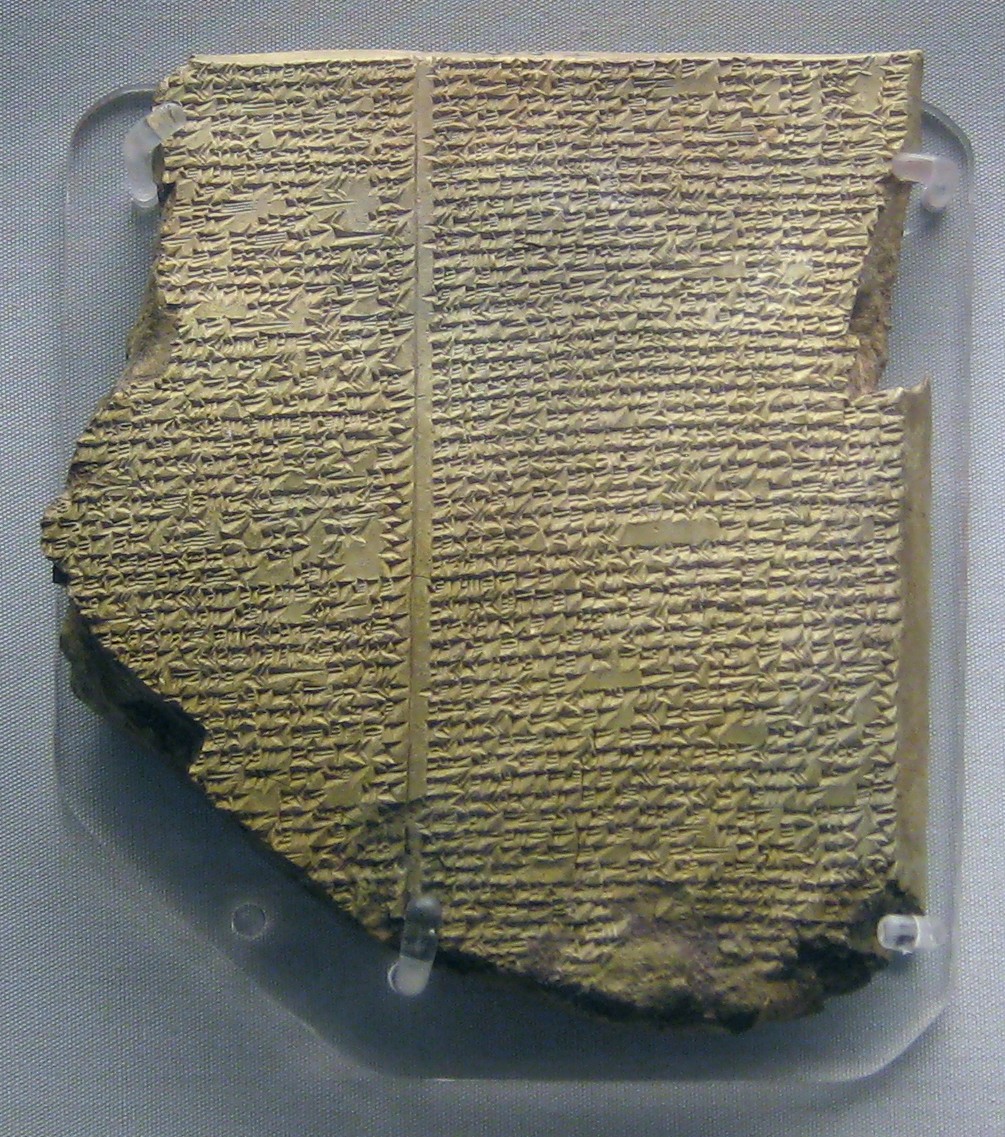
DOCUMENTED — as a text. The most complete ancient telling stands in Tablet XI of the Epic of Gilgamesh, where the survivor himself tells it. Gilgamesh has crossed the waters of death to find Utnapishtim — "he found life" — the one man made immortal, and asks how he won that gift. Utnapishtim answers: "I will reveal to you a secret of the gods."
DOCUMENTED — the telling, in its own order. The great gods resolve on the flood; their oath binds them. But Ea repeats their words to Utnapishtim's reed hut — "Reed hut, reed hut! Wall, wall! Listen, reed hut; take note, wall" — and tells him to tear down his house, build a ship of equal width and length, roofed like the deep, and take aboard the seed of all living things. Utnapishtim loads his family and kin, the beasts of the field, and craftsmen of every craft — the skills of the world ride in the boat with the seed of its life — and the door is shut behind him.
DOCUMENTED. At dawn a black cloud rises; the storm god thunders within it. "The Anunnaki lifted up the torches, setting the land ablaze with their flare." Brother does not see brother. Even the gods are afraid, retreat to the highest heaven, and cower "like dogs crouched by an outside wall," while Ishtar screams like a woman in childbirth that the people she bore now fill the sea like fish spawn. The storm rages six days and seven nights; on the seventh it subsides, and Utnapishtim looks out on a mankind turned to clay, and weeps. The ship grounds on Mount Nimush. On the seventh day there he releases a dove — it returns; a swallow — it returns; a raven — it sees the waters receding, eats, caws, and does not return. He opens the boat to the four winds and offers sacrifice on the mountain's peak, and the gods smell the sweet savour and gather "like flies" over the offering.
DOCUMENTED — the rebuke and the gift. Enlil arrives, sees the ship, and is furious that any man escaped. Ea answers him to his face, in the telling's moral centre: he rebukes the chief god for laying the flood on mankind without reflection — "Lay upon the sinner his sin; lay upon the transgressor his transgression — but be lenient, lest he be cut off entirely." Enlil is persuaded. He boards the ship, touches the foreheads of Utnapishtim and his wife, and blesses them: "Formerly Utnapishtim was mortal; now Utnapishtim and his wife shall be like gods." They are taken to live far away, at the mouth of the rivers — and Gilgamesh, who came for the secret, must return without it. Copies of this tablet lay in Ashurbanipal's library at Nineveh; in December 1872 the flood tablet was deciphered and read aloud to the learned world for the first time in over two thousand years, and the likeness of its sequence to the flood of Genesis, point by point and in the same order, made it a sensation. The Watchers material that stands behind the Mesopotamian world of gods and giants is carried in its own class, The Watchers in the Texts.
§5 — THE COLLECTION'S OWN TEXT: NOAH, IN GENESIS
The telling, as the canon carries it (Genesis 6–9). The earth is filled with violence, and mankind's wickedness is great. Noah, a righteous man, blameless in his generation, is warned and commanded: make an ark of gopher wood, pitched within and without, of given measure, and take into it his household and the animals — of clean beasts by sevens, of others by pairs — and food for all. The fountains of the great deep break open and the windows of heaven are opened; rain falls forty days and forty nights; the waters rise above the highest mountains under heaven, and all flesh dies that moves on the earth. The ark rests on the mountains of Ararat. Noah sends out a raven, then a dove — three times — until the dove does not return. He removes the covering of the ark and sees the face of the ground dry. On leaving the ark he builds an altar and offers burnt offerings, and the soothing savour rises. Then the covenant: never again shall all flesh be cut off by the waters of a flood, and the bow is set in the cloud as its sign. Noah plants a vineyard; the generations of the nations descend from his three sons.
DOCUMENTED — the comparison, exactly as far as it goes. Set beside the Mesopotamian tellings, the shared sequence is real: a divine decision, one man warned, a vessel built to measure, family and animals and the seed of life aboard, a storm, a grounding on a mountain, birds sent out, a sacrifice on disembarking whose savour rises. The differences are equally real, and neither side is flattened here: the reason — human noise disturbing the gods, against human wickedness and violence judged; the warner — a god circumventing another god's oath through a reed wall, against the one God who both judges and warns; the duration — a storm of seven nights against a chronology of months; the ending — immortality for one couple, removed to the mouth of the rivers, against a covenant made with every living creature and a world handed back to a mortal man. Whether transmission ran through the exile in Babylon or through earlier contact in the Levant is DEBATED in the scholarship and carried here at that weight.
§6 — BABYLON IN GREEK DRESS: BEROSSUS AND THE TABLETS AT SIPPAR
DOCUMENTED — as fragments. Around 290 BC a priest of Bel at Babylon named Berossus wrote a history of Babylon in Greek for the land's new rulers. His book is lost; the flood passage survives in later writers' quotations of it. The hero's name comes back in its Sumerian shape: Xisouthros — Ziusudra — tenth and last king before the flood. The god Cronus, the Greek mask for Ea, appears to him in a dream and names the very day the flood will come.
DOCUMENTED. Then comes the command found in no earlier surviving telling — the reason Berossus has his own section. Before he builds the boat, Xisouthros is to write down the beginning, the middle, and the end of all things, and bury the tablets at Sippar, the city of the Sun — so that knowledge itself survives the water, and can be dug up on the other side. The boat is built, five stades long and two broad, loaded with family, friends, provisions, birds and animals. The flood comes and quickly departs. Birds are sent out three times: the first return, finding neither food nor rest; the second return with mud on their claws; the third do not return. The ship grounds on a mountain in Armenia. Xisouthros disembarks with his wife, his daughter, and the pilot, raises an altar, sacrifices — and vanishes, taken to dwell with the gods. A voice from the air directs the rest: be pious, go to Sippar, dig up the buried writings, and deliver them to mankind. The survivors do so, and rebuild Babylon itself. Life survives in the boat. Learning survives in the ground at Sippar.
§7 — GREECE: DEUCALION AND PYRRHA, AND THE STONES THAT BECAME PEOPLE
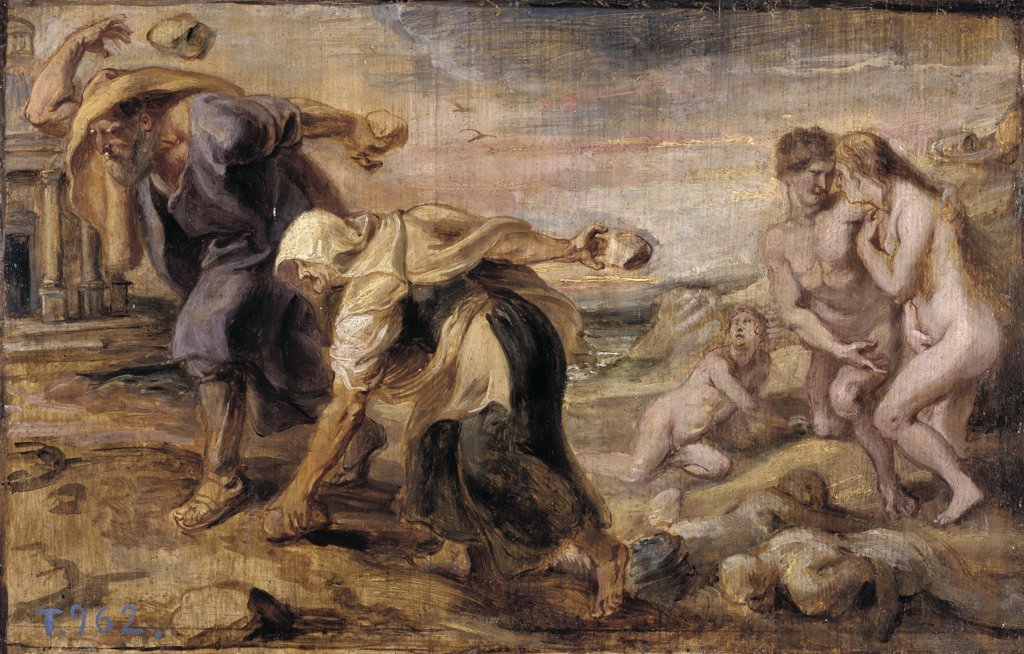
DOCUMENTED — as texts. The Greek telling stands in its fullest prose form in Apollodorus's Library and its most famous poetry in Ovid's Metamorphoses, Book 1; Pindar already knows Deucalion and Pyrrha descending from Parnassus five centuries before Apollodorus. Zeus, hearing of the wickedness of men, resolves to destroy the age of bronze mankind by flood. Prometheus, who foreknew it, tells his son Deucalion to build a chest. Deucalion stocks it and boards with his wife Pyrrha. Zeus pours down the rain; Greece is flooded; all men perish except a few who flee to the high mountains. For nine days and nine nights the chest drifts, and comes to rest on Mount Parnassus, where Deucalion sacrifices to Zeus, god of escape.
DOCUMENTED — the stones. Then the repopulation — this telling's signature, found nowhere else in this class. The two survivors, alone in an emptied world, consult the oracle of Themis: how shall the race be restored? The answer comes as a riddle: leave the temple with heads covered and garments loosed, and cast behind you the bones of your great mother. Pyrrha recoils — until Deucalion reads it truly: our great mother is Earth, and her bones are her stones. Veiled, not looking, they throw the stones backward over their shoulders. The stones Deucalion throws become men; the stones Pyrrha throws become women. Ovid lingers on it: the stones soften, take shape, veins run in them — "hence we are a hard race, able to bear toil." The Greek telling keeps the wordplay in its own tongue: the people are laoi, it says, from laas, a stone. Greece kept more than one flood in memory — the flood of Ogyges, reckoned older still — and Plato's Egyptian priest tells Solon the Greeks remember only one deluge, though there have been many (see the pair class, §2).
§8 — INDIA: MANU AND THE FISH
DOCUMENTED — as a text. India's flood stands first in the Śatapatha Brāhmaṇa, a prose ritual text of the late Vedic period — its fixation is generally placed in the 8th–6th centuries BC, the dating DEBATED within that span. It is the story's earliest form, and in it the fish is not yet named as any god. In the morning they bring Manu water for washing, as they still do. In the water a small fish comes into his hands, and speaks: "Rear me, and I will save you." — "From what will you save me?" — "A flood will carry away all these creatures; from that I will save you." While we are small, the fish says, destruction is great for us: fish devours fish. Keep me first in a jar; when I outgrow it, dig me a pit; when I outgrow that, take me down to the sea, for then I shall be beyond destruction.
DOCUMENTED. Manu does so. The fish grows into a great fish, largest of fish, and names the year of the flood in advance: in that year, build a ship, and wait for me. The flood comes. Manu boards; the fish swims up, and Manu ties the ship's rope to its horn, and the fish tows him across the waters to the northern mountain. There: tie the rope to a tree, and as the water subsides, descend gradually with it. That slope is still called Manu's Descent. The flood has carried away all creatures, and Manu alone remains. Desiring offspring, he offers a sacrifice of butter, sour milk, whey and curds into the waters, and after a year a woman is produced from it — and through her comes the race of Manu, which is mankind.
DOCUMENTED — how the telling grew. In the Mahābhārata the story returns enlarged: the fish is revealed as Brahmā, and Manu brings aboard the seven sages and the seeds of all things — the seed of all things carried through the water, as in Mesopotamia. In the Purāṇas the fish becomes Matsya, the fish-incarnation of Vishnu, and it is in that form — the great fish towing the boat — that the telling lives in India's art and devotion to this day. Each layer stands in its own text; none is read back into the earliest form here. A public-domain artwork of Matsya from a public collection was sought for this class and not verified in this pass; it stands owed, and is not replaced by an unverified image.
§9 — CHINA: GUN AND YU — THE FLOOD MASTERED, NOT ESCAPED
DOCUMENTED — as texts. China's great flood stands in its earliest histories and classics — the Shangshu (Book of Documents) tradition, the Mencius, and the later standard histories — as the founding labour of ordered civilisation. It is this class's great counter-example, taught exactly so: in the Chinese telling there is no ark, no chosen family, and no world emptied and begun again. In the time of the emperor Yao the flood waters rise year after year — "the flood waters assail the heavens" — the people are driven to nests in the trees and dens in the hillsides, and the land cannot be farmed. The task of mastering the waters falls to Gun. His method is blocking: dikes and dams, raised for nine years — in the tradition, built with a marvellous self-growing soil stolen from heaven. The method fails; the waters rise the higher for being penned. Gun is executed at Feather Mountain, and the task passes to his son.
DOCUMENTED. Yu reverses his father's whole doctrine of water. Instead of damming, he dredges and leads: he studies the lay of the land, cuts channels through the mountains — the cutting of Longmen, "Yu's Gateway," on the Yellow River is the famous instance — deepens the riverbeds, and guides the waters along the land's own fall to the sea. The work takes thirteen years, and the tradition's measure of the man is indelible: in those thirteen years Yu passed his own door three times, and did not enter — once, hearing his newborn child crying within. When the waters are mastered, Yu orders the land itself: he surveys and fixes the Nine Provinces, their soils, products and tribute — the survey that stands for centuries as China's charter of its own geography. Yu receives the throne and founds the Xia, counted in the traditional historiography the first dynasty. Every other telling in this class answers the flood by preservation — a remnant carried through the water. The Chinese telling answers it by work. The flood in China is a problem of government, and the memory is shaped by a river civilisation whose survival genuinely depended on such works.
§10 — MESOAMERICA: WORLDS ENDED BY WATER AMONG THE SUNS
DOCUMENTED — as texts. The Mexica (Aztec) ordering of the world's ages is the doctrine of the Five Suns, recorded in the post-conquest codices — the Leyenda de los Soles is its fullest text — and carved at the centre of the great Sun Stone: each age is a sun, ruled by a god, peopled by its own mankind, and ended by its own destruction. The ages fall in order: the first sun ends by jaguars; the second by wind, its people turned to monkeys; the third by a rain of fire. The fourth sun is Nahui Atl — Four Water — ruled by Chalchiuhtlicue, "she of the jade skirt," goddess of rivers and lakes. Its years run in the codices' reckoning to 676. Then the sky of that age collapses in flood: the waters rise and cover the mountains, the people are turned into fish, and the fourth sun ends in water entire. Afterward the gods raise the fallen sky, and in due course the fifth sun — the present age, fated to end by earthquake — is kindled.
DOCUMENTED — as a text; TRADITION — the K'iche' telling. In the Popol Vuh, the council book of the K'iche' Maya of highland Guatemala — written down in alphabetic K'iche' in the 1550s, from a tradition older than the writing — the makers attempt mankind more than once. The mud people dissolve. Then come the wooden people: they walk, multiply, build houses — but they have no hearts, no minds, no memory of their makers. So the Heart of Sky sends their destruction: a flood rises against them, a heavy resin rains from the sky, and their own animals, grinding stones, pots and dogs rise up and turn on them. Those who escape into the forest become the monkeys — the Popol Vuh points at the monkeys of the forest as the remnant and the sign of the wooden age. Only afterward are true people made — of maize. In Mesoamerica the flood is one destruction among a series, inside a counted sequence of worlds: the water takes its turn with jaguar, wind, and fire, and the present world is understood from the start to be mortal, as its four predecessors were.
§11 — THE INDIGENOUS NATIONS OF NORTH AMERICA, AT THEIR PUBLISHED RECORD
TRADITION — the strand's discipline, stated once. These traditions are carried as the peoples' own, witness-labelled, from the published ethnographic record only, and named to their own nations. In these tellings the flood is most often not the end of the story but the middle of it — the making of the present earth is the point.
TRADITION — Anishinaabe (Ojibwe), at its published record. In the Anishinaabe telling, the flood comes first and the earth is made after it. Wenabozho (Nanabozho), fleeing the rising waters, climbs a pine that stretches upward as the water climbs, until his nose is barely above the surface; in another published telling he rides a raft on a world that is all water. There is no land left anywhere, and land must be remade — from the old earth, under the water. So the diving begins. The loon dives, and dies in the attempt. The otter fails; the beaver fails. Then comes the muskrat — the smallest, the one not thought of. The muskrat dives, is gone long, and floats up senseless — in some tellings dead — but with a few grains of earth held in his paws. From those grains Wenabozho remakes the land: he sets the earth growing, sends a great bird flying around it so the land grows as the bird flies, and after four days sends the eagle to grow it larger. The peoples' own name for the continent this telling makes is Turtle Island — in the widely told form, the new earth is spread on the great turtle's back. The difference from every boat in this class is the telling's own teaching: nothing is preserved through the flood — the world is re-created out of it, and the creature who saves it is not the strongest diver but the muskrat.
TRADITION — Cherokee, at its published record. The Cherokee telling stands in Myths of the Cherokee, published 1900, under the title "The Deluge." A long time ago a man had a dog, which began to go down to the river every day and look at the water and howl. The man scolds the dog, and the dog speaks: very soon there will be a great freshet; the water will come so high that everybody will be drowned — but if the man will make a raft, he can be saved; first, the dog says, you must throw me into the water. The man does not believe. The dog offers a sign: "look at the back of my neck" — and the skin of its neck is worn away so that the bones show, from watching and howling at the river. Then the man believes, and builds the raft, and takes his family aboard with plenty of provisions. It rains for a long time; the water rises until the mountains are covered, and all the people in the world are drowned. Then the rain stops and the waters go down. Now there is no one alive but the man and his family — but one day they hear a sound of dancing and shouting on the other side of the ridge. The man climbs and looks over: everything is still, but all along the valley lie great piles of bones of the people who were drowned — and he knows that the ghosts have been dancing. The published record adds the teller's own account of it: the flood was explained by its Cherokee teller as an upheaval and tilting of the earth, so that the waters for a time overflowed the inhabited parts.
TRADITION — Hopi, at its published record. The Hopi count the worlds in sequence, as the Mexica do. Twice the people grew corrupt and twice the world was ended — by fire, then by cold — the few who kept the laws of creation sheltered underground with the ant people. In the Third World the people multiplied into cities and nations, took to war, and built great shields on which they flew to attack one another. Then Sotuknang resolved to end that world by water, "lest the people with the song in their hearts are corrupted and killed off too." Spider Woman gathers the chosen. Along the shore she cuts down giant reeds, and places each person inside a hollow stem, with a little water and a little cornmeal dough, and seals them in. Then the waters are loosed: "Waves higher than mountains rolled in upon the land. Continents broke asunder and sank below the seas." The people float in their reeds for a long time. When the movement stops, Spider Woman unseals the reeds on a small piece of land on a mountaintop, and the people come out with as much food as they started with. They send out birds, which return; they grow a tall reed and climb it, and see only water. Then they take to the reeds again as boats, travelling northeast from island to ever-larger island, paddling as if uphill — until they come to the shores of the Fourth World, this world, and look back to see the islands, the last remnants of the Third World, sink beneath the sea.
DOCUMENTED — the pattern inside the section. Set in a row, the North American tellings answer the water in three different vessels: a raft the survivor builds because a dog told him to (Cherokee); no vessel at all, but a new earth dived for (Anishinaabe); and the people themselves sealed inside the vessel, stem by stem (Hopi). None of the three is a retelling of any other. Each is its nation's own.
§12 — THE PATTERN THE RECORD ACTUALLY SHOWS
DOCUMENTED. The written record opens in Sumer by the 17th century BC and has not closed since — Sumerian, Akkadian, Babylonian-in-Greek, Hebrew, Greek, Latin, Sanskrit and Chinese texts, Mexica and K'iche' books, and the spoken traditions of the Indigenous nations at their published record; and beyond this class's scope, flood traditions stand in the published record of peoples on every continent. The universality is a fact of the record, not a flourish: wherever peoples have kept their oldest stories, a great water is in them.
DOCUMENTED — the likenesses, at their exact weight. Across the oldest cluster — the Mesopotamian tellings and Genesis — the sequence of warning, vessel, storm, mountain, birds, and sacrifice is shared point by point, and scholarship treats a historical connection within that cluster as the natural reading (DEBATED only as to route and date). Beyond that cluster the likenesses loosen to a common skeleton — water ends a world; a remnant survives; a new order begins — while the flesh on the skeleton is each nation's own: the fish, the stones, the dredging, the muskrat, the reeds, the wooden people, the dancing ghosts.
DOCUMENTED — five answers to the water. The differences are taught as carefully as the likenesses, because they are not interchangeable: escape by vessel (Mesopotamia, Genesis, Greece, India); preservation of knowledge beside preservation of life (Berossus — the tablets at Sippar); mastery by labour (China — no vessel, no remnant, a land re-ordered); re-creation from the deep (Anishinaabe — the earth remade from a muskrat's pawful); succession of worlds (Mesoamerica and the Hopi — the flood as one ending in a counted series, the present world mortal as the last). A history that keeps only the likenesses has flattened the record; a history that keeps only the differences has missed the fact that the water is remembered at all. This class keeps both.
DOCUMENTED — the boundary, kept from the pair class. The pair class carries the floods the stones record — real regional megafloods, documented basin by basin — and states plainly that no worldwide stratum of human time is carried by the geological record. This class adds nothing to that finding in either direction. What it carries is the other half of the evidence: that humanity, on every continent, in languages unrelated and traditions unwritten until yesterday by the calendar of clay, kept the memory of a world-ending water at the centre of its oldest stories — and shaped that memory, each nation, into its own image of how the world is lost and how it begins again. The flood remembered everywhere is itself the arc's evidence. What stands behind the remembering, the record of the texts does not by itself decide, and this class does not pretend otherwise. The dates of these tellings take their places in the Chronology.
Sources
Ancient sources named in the text: the Sumerian flood story (the Eridu Genesis; ETCSL) · the Sumerian King List · Atrahasis · Epic of Gilgamesh, Tablet XI · Genesis 6–9 · Berossus, Babyloniaca, fragments preserved in later quotation · Apollodorus, Library 1.7 · Ovid, Metamorphoses 1 · Pindar, Olympian 9 · Śatapatha Brāhmaṇa 1.8.1 · Mahābhārata · the Purāṇas (Matsya) · Shangshu ("Tribute of Yu") · Mencius · Leyenda de los Soles (Codex Chimalpopoca) · Popol Vuh.
Published ethnographic record named in the text: Wisconsin Chippewa Myths and Tales (1977), the Anishinaabe (Ojibwe) tellings · Myths of the Cherokee (1900), "The Deluge" · Book of the Hopi (1963), the Third Mesa telling. Full attributions stand in the extraction file's Research log.
Read beside this class: Floods and the Sunken Lands — the pair class (the stones) · The Tablets Speak · The Watchers in the Texts · Chronology.
Record: THE_FLOOD_TRADITIONS_OF_THE_NATIONS_2026-10-28.md (study_materials/world_history).